Upload your design & get your customized product.



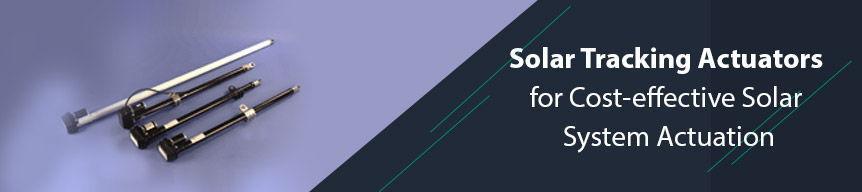
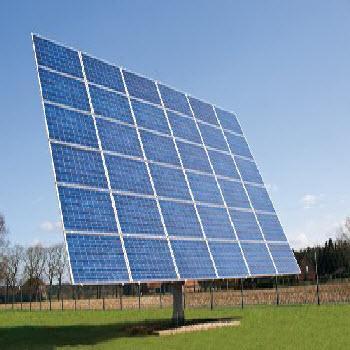
Always aware of the world’s need for efficient renewable energy sources, Venture Mfg. Co. once again is leading the industry by offering solar tracking actuators in specified force, stroke, length, and speed. The robust and efficient solar linear actuators can be seamlessly integrated with your solar panel tracking systems ,resulting in creating a smooth, precisely-controllable motion. Our range of solar tracker actuators provides a cost-effective solution for controlling a solar tracker’s elevation, and tracking of CSP (Concentrating Solar Power) and CSV (Concentrating Photovoltaic) systems.
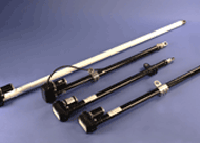
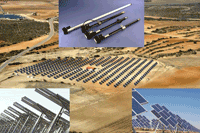
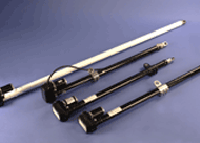
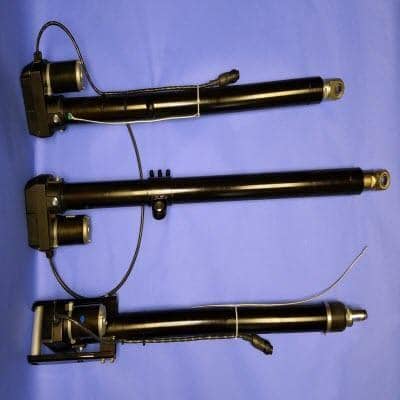
Venture is working with some of the best solar power providers, both large and small, from around the world to develop and produce a complete line of actuators to meet the needs of the solar industry. Over the years, we have designed and delivered actuators for customized renewable energy trackers, screw jacks for solar tracking systems, solar tracking precision gearboxes, and actuators for solar panels among others.
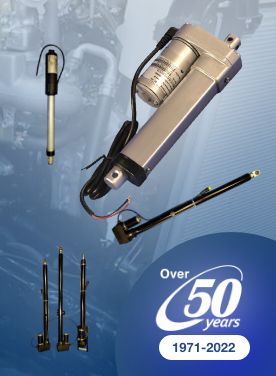
Currently, we offer the following models of solar linear actuators that are proven to withstand harsh conditions in the solar industry
Our actuators used in the solar applications are known for the following beneficial features:
As mentioned earlier, these budget-friendly actuators can be integrated to automate the following equipment used in the solar tracking and renewable energy sectors.
Venture’s linear actuators are also used in light manufacturing units, renewable energy grids, and other non-conventional power generation plants. With our high-end ACME screw solar actuators and ball screw solar actuators, you can be assured of the best solar tracking performance.
1. What is the difference between CSP and CPV solar tracking, and how does actuator selection change between them?
CSP systems concentrate sunlight to generate heat, while CPV systems focus light onto photovoltaic cells to generate electricity directly. Both rely on precise positioning, so Venture Mfg. Co.'s Solar Tracking Actuators are built with fine-tuned speed and load ratings to match either setup. The right actuator choice usually comes down to panel weight, mounting style, and how much positioning precision the tracking system demands.
2. What is the difference between the Acme Screw Solar Actuator and the Ball Screw Solar Actuator for tracking applications?
An Acme screw actuator generally provides good load-holding capability and can resist back-driving, making it suitable for applications where maintaining position is important. A ball screw actuator typically offers higher mechanical efficiency and lower friction, making it suitable for applications requiring smoother or more frequent movement and higher efficiency.
3. What load capacity and static hold strength does the Standard Solar Acme Actuator provide?
The Standard Solar Acme Actuator is rated for a 15000N load capacity with a 20000N static hold, giving it a strong super hold capability for keeping panels steady under wind and weight. Combined with a stainless-steel inner tube and heavy-duty brackets, this Electric Linear Actuator is built to perform reliably across seasons without losing positioning accuracy.
4. What makes the Standard Solar Ball Screw Actuator's IP65 rating important for outdoor solar installations?
An IP65 rating means the actuator is well sealed against dust and low-pressure water jets, which matters a lot for solar farms exposed to rain, wind, and debris. This protection helps the Standard Solar Ball Screw Actuator keep its internal components safe from moisture damage, supporting a longer service life in demanding outdoor tracking environments.
5. When should I choose the Heavy-Duty Solar Ball Screw Actuator over the standard version for a large-scale solar park?
If your project involves larger panel arrays, higher wind exposure, or a need for continuous reliable movement across many tracking cycles, the Heavy-Duty Solar Ball Screw Actuator is the better fit. It is engineered specifically to stand up to tougher environmental challenges, making it a preferred choice for medium and large-scale solar park installations.
6. Does the Heavy-Duty Solar Ball Screw Actuator's double clevis mounting option simplify tracker installation?
Yes, the double clevis mounting design allows for secure, pivoting attachment points on both ends of the actuator, which makes alignment easier during installation and helps absorb slight movement without stressing the actuator body. This is especially useful for larger tracker frames where mounting flexibility matters.
7. What customization options are available for solar thermal equipment using Venture Mfg. Co.'s Custom Design Solar Tracking Actuators?
Venture Mfg. Co. can adjust stroke length, mounting configuration, load rating, and motor type to fit unique solar thermal setups. Whether you are working with CSP mirrors, heliostats, or specialized tracker frames, the Custom Design Solar Tracking Actuators option ensures the final product matches your equipment specifications rather than forcing a standard fit.
8. What replacement parts are available for aging or damaged solar tracking actuators, such as tube assemblies or motor gearboxes?
Depending on the actuator design, replacement components may include tube assemblies, motors, gearboxes, mounting components, and complete actuator assemblies. Replacing individual components can sometimes extend the service life of an existing tracking system without replacing the complete actuator.
9. What makes the 1200 Series Linear Actuator suitable for heavy duty commercial solar tracking applications?
Built with durable construction for dependable performance, the 1200 Series Linear Actuator is designed to handle the demands of heavy-duty commercial settings, including larger solar tracking arrays. Its rugged build makes it a solid option when standard actuators are not strong enough for the application's load and cycle requirements.
10. How do I decide between a Standard Solar Acme Actuator, a Standard Solar Ball Screw Actuator, and a Heavy-Duty Solar Ball Screw Actuator for my project?
Start by evaluating the required load, holding force, movement frequency, efficiency, environmental exposure, and duty cycle. Acme screw actuators may be suitable when load holding is important, ball screw actuators can provide higher efficiency and smoother movement, and heavy-duty ball screw designs may be appropriate for higher-load or more demanding tracking applications.